Spinal cord injury
2 articles
A spinal cord injury interrupts the signals between the brain and the body below the injured level. The effect depends on the level of the injury (neck, chest or lower back) and on whether it is complete or partial (incomplete): in a partial (incomplete) injury some movement or sensation remains below the level, and the outlook for walking is generally better.
Rehabilitation aims to prevent complications such as pressure sores, contractures (joint stiffness) and bladder and bowel problems, and to build strength, balance, transfers and, where possible, walking. Robot-assisted gait training may be one part of the programme for suitable patients; suitability is decided by a neurorehabilitation-focused physical medicine and rehabilitation (PM&R) specialist after examination.
Where to start: read the spinal cord injury guide, then Walking after spinal cord injury and Robotic physiotherapy and rehabilitation.
Your physical medicine and rehabilitation specialist and the physiotherapist plan the programme and review progress at regular intervals.
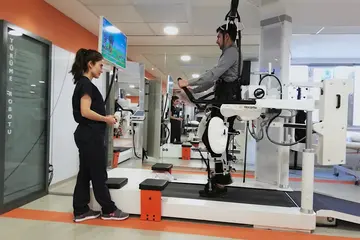 Robotic Physiotherapy and Rehabilitation: Who Benefits and How It WorksGait and arm–hand robots, who may benefit, what a session looks like, the evidence and realistic expectations.
 Walking After Spinal Cord Injury: Prognosis by Injury LevelComplete vs partial (incomplete) injury, the ASIA scale, factors that predict walking and rehabilitation options including robotic gait training.